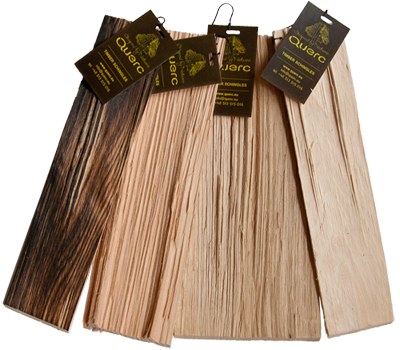
Knowledge and material
How to choose wood shingles for a roof
The choice of species starts with the place, not a table. A roof, façade, outbuilding and organic form each ask different things of the material.
Four starting points
- Oak — the hardest and most expressive, for demanding work.
- Larch — resinous and proven on roofs and façades.
- Pine — light and economical for larger areas.
- Hardened pine — darker, with a strong material character.
The best choice comes from discussing roof pitch, shingle length, exposure and how you want the wood to age.
Moisture is part of the design
Wood is hygroscopic: it exchanges moisture with its surroundings. That is not an argument against shingles; it is a reminder that service life starts with shedding water, allowing drying and getting the details right.
A species does not provide a guaranteed number of years by itself. Roof pitch, exposure, ventilation, flashings, fixings and local climate all affect performance.
Questions to ask before ordering
- What are the pitch and orientation of the roof?
- Are any areas especially exposed to water, snow or shade?
- Which shingle length fits the geometry and scale of the building?
- How will the ridge, eaves, valleys and roof penetrations be detailed?
- Do you want natural greying, or are you planning a surface finish?
A good conversation before ordering matters more than choosing the “most durable” species from a catalogue. Samples show not only colour, but also thickness, profile, edge and how the material reads across a larger surface.
The material is the beginning, not the whole roof
A shingle is the visible layer of a larger assembly. The substrate, drying paths, flashings and fixing method must meet local building requirements. For a new house, discuss the build-up with the designer and installer before ordering material.
Each species answers a different question
Oak brings hardness, weight and a pronounced grain. Larch has a resinous, warmer character. Pine makes sense when a larger surface needs to remain calm and economical, while hardened pine changes above all the reading and expression of the surface.
Not every difference between species should be described as an advantage. Sometimes the right material is the one that fits the proportions of the building, the budget and the way the owner intends to maintain it.
Check the section before choosing the colour
A photograph makes colour easy to compare, but thickness, profile and edge behaviour are harder to see. Ask for samples of several species and place them together in light similar to the light in which the building will be seen.
This comparison does not replace design or calculations. It helps make the decision consciously: not around a promise of permanent newness, but around material, detail and the ageing you expect.